很可惜 T 。T 您现在还不是作者身份,不能自主发稿哦~
如有投稿需求,请把文章发送到邮箱admin@aa.com,一经录用会有专人和您联系
咨询如何成为春羽作者请联系:上海新闻网高速路况小羽毛
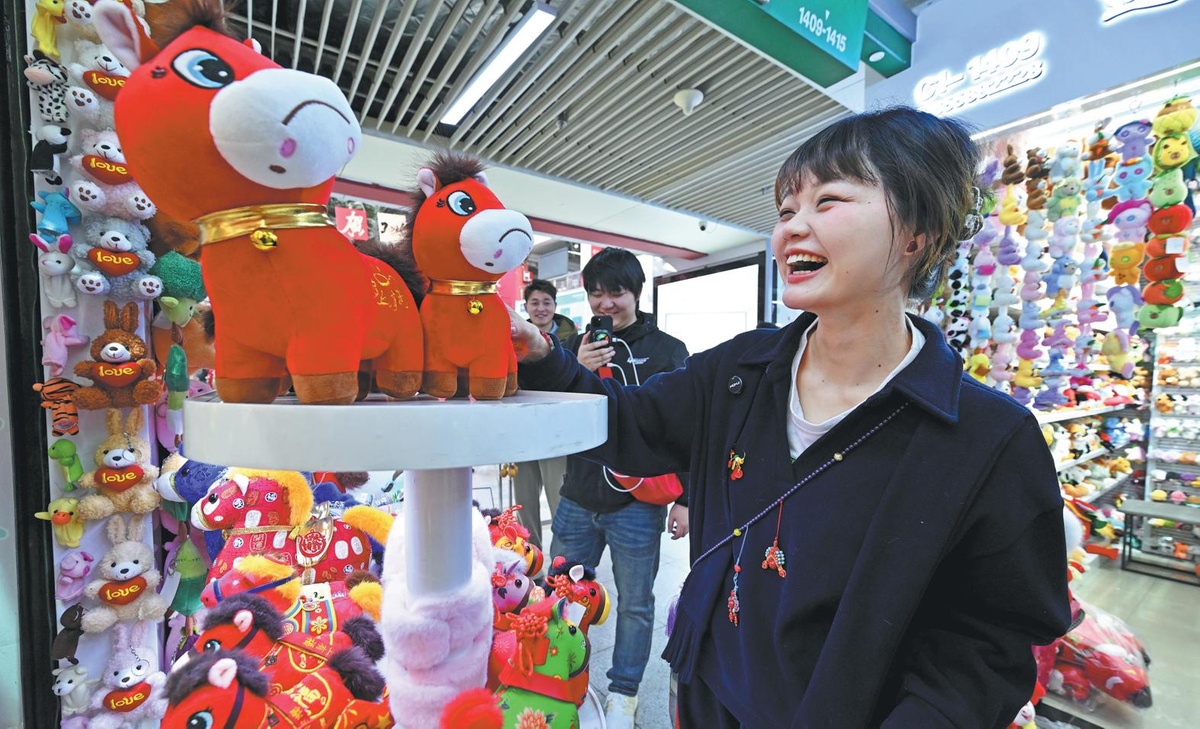
The 霍邱新闻网app"crying horse" stuffed toys attract people's attention at the Yiwu International Trade City in Yiwu, East China's Zhejiang province, on Jan 12. LYU BIN/FOR CHINA DAILY
As China heads into the Year of the Horse, consumer demand is being released earlier than usual, propelled by the country's longest Spring Festival holiday on record and a coordinated policy push aimed at turning seasonal spending into sustained economic momentum.
The 2026 Spring Festival holiday will run from Feb 15 to 23, spanning nine consecutive days. The extended break — longer than in previous years — is not only reshaping travel and spending plans, but also amplifying the effects of policies designed to unlock consumption potential, particularly in services, travel and experience-driven spending.
From bustling shopping streets in Beijing to small factories in Zhejiang's Yiwu operating extra production lines, and from reunion dinners booked weeks ahead of Chinese New Year's Eve to a sharp rise in two-way travel, signs of renewed consumption activity are emerging well before the holiday officially begins.
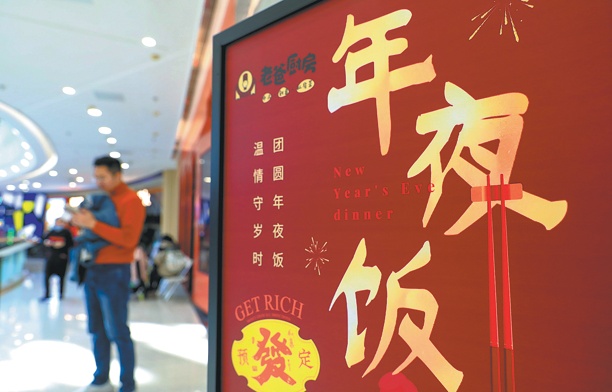
A special "Chinese New Year's Eve dinner" reservation advertisement is launched by a restaurant at a mall in Shanghai on Dec 14. CHINA DAILY
On Beijing's Wangfujing pedestrian street, winter temperatures have done little to slow foot traffic. Flagship stores are drawing a steady stream of overseas visitors, many taking advantage of expanded visa-free access and increasingly seamless digital payment options.
Daniel Chan, a tourist from Los Angeles, stepped out of an electronics store with a newly purchased DJI Osmo Nano camera.
"I've wanted this model for months. It's almost impossible to find stock back home, yet here it was available, and the price was very friendly,"Chan said. "It's not just a souvenir — it's cutting-edge technology."
He said he had already started using the camera on the day of purchase. "I haven't explored all its functions yet, but the magnetic design and image quality are quite good," he added.
What impressed him most during his China trip, Chan said, was the speed and convenience of food delivery services. "It's incredibly fast and efficient — almost unbelievable," he said. Dining in restaurants was equally striking, with some offering dish countdown timers and guaranteed serving speeds. "I've hardly ever experienced service like this in the United States."
Such experiences are precisely what policymakers hope to encourage.
The "Shopping in China" campaign, first launched in April 2025, aims to create a more internationally friendly consumption ecosystem while stimulating domestic demand through higher-quality supply.
At the launch of the 2026 "Shopping in China" and New Year Consumption Season in Shanghai on Jan 3, Commerce Minister Wang Wentao said the initiative would focus on goods consumption, services consumption and the development of new consumption scenarios. A series of nationwide events, including a premium consumption month and an international consumption season, will be rolled out, alongside locally tailored programs in 15 pilot cities.
With the nine-day Spring Festival approaching, Wang said the Ministry of Commerce, together with other central departments and local governments, will host a "happy shopping for the Spring Festival" campaign as a flagship component of the "Shopping in China" series. The campaign will span food, accommodation, transport, travel, shopping and entertainment, aiming to create an inclusive, festive consumption experience for families at home and travelers on the move.
More than 1,200 kilometers south of Beijing, Yiwu — the world's largest small-commodities hub — offers a ground-level view of how festive demand is being converted into real orders.
In the plush toy section of Yiwu International Trade Market, one horse-themed product has become an unexpected viral hit. Originally launched in mid-October under the name "Mashang Youqian", meaning "immediate prosperity", the toy initially sold about 400 units a day — steady but far from a bestseller.
Its breakout moment came in January, after a minor production-line error resulted in the toy's mouth being stitched incorrectly, giving it a seemingly "tearful" expression. Buyers who received the flawed version posted photos and chat records online while requesting exchanges. The images struck a chord with netizens, who found humor and resonance in the toy's "wronged" look, quickly propelling it to the top of social media trending lists.
Dubbed the "crying horse", the toy was soon labeled the first cultural "dark horse" of the New Year. As demand surged, the factory expanded production lines from two to more than a dozen, lifting daily output to around 15,000 units. The merchant has since applied for a design patent.
Behind the viral moment, the success mirrors quality and Yiwu merchants' deeply ingrained ability to respond quickly to market signals, from identifying trends to making swift decisions and scaling production with minimal delay.
Across the toy sector, creative interpretations of the Year of the Horse are proliferating. Products range from zodiac photo frames to blind boxes and decorative figurines.
Some bestselling items now sell between 40,000 and 60,000 units a day. For popular designs, factories are producing between 50,000 and 100,000 units daily. To maintain speed and creativity, some merchants require their design teams to develop as many as five new styles each day.
Merchants say interest from foreign buyers has risen, particularly after Spring Festival was added to UNESCO's Representative List of the Intangible Cultural Heritage of Humanity in December 2024.
Consumption momentum is also visible in the catering sector, where Chinese New Year's Eve reunion dinners — a core element of Spring Festival culture — are being booked out well in advance.
In Beijing, several restaurant chains report that all private rooms across multiple branches are already fully booked, with only limited lunchtime slots remaining. Prices largely match regular menus, though advance reservations and deposits are typically required.
To cope with demand, many restaurants have introduced staggered dining slots on Chinese New Year's Eve, offering discounts for later sittings. Others have expanded takeaway services, allowing families to enjoy freshly prepared reunion meals at home.
One restaurant in Beijing's Guomao area has launched two takeaway packages priced at 1,988 yuan ($286) for eight to 10 people and 999 yuan for four to six people, with free delivery within the city's Fifth Ring Road. Customers can also order a la carte, providing greater flexibility.
An emerging trend is the shift toward county towns and rural venues. In Yinjiang town of Ningbo, Zhejiang province, a countryside resort that opened reservations three months ago, has already sold out large private rooms for the first two days of the holiday, attracting families traveling from neighboring Shanghai, and Jiangsu province.
Traditional restaurant brands are also moving into rural markets. Managers say demand for reunion dinners and banquets in these areas remains strong, while the supply of mid — to high-end dining options is relatively limited — creating new opportunities for expansion.
The nine-day break is also reshaping travel patterns, triggering a surge in both outbound and inbound tourism.
Major travel platforms report that Spring Festival bookings for 2026 have surpassed last year's levels across the board. According to data from Flight Master, as of Jan 16, bookings for domestic flights during the holiday exceeded 4.13 million, up about 21 percent year-on-year. Outbound and inbound flight bookings both climbed to around 700,000.
Airbnb data show searches by Chinese travelers for overseas accommodation around the Spring Festival period have roughly doubled year-on-year. Many travelers are choosing to stagger trips before or after the official holiday to secure better prices and less crowded itineraries.
Travel agencies are embedding New Year elements into overseas tour products, allowing travelers to retain a sense of festivity even while abroad.
Li Mengran, marketing manager of Beijing-based travel agency Utour, said the company has continued its long-standing practices in European tour products. These include customized reunion dinners and dumpling-making activities, alongside wine tastings and interactive prize draws.
"For family travelers, we also prepare red-envelope gifts for children under 16 to enhance the sense of ritual and warmth during the journey,"Li said.
Domestically, culturally rich "intangible heritage towns" are emerging as popular destinations. Data from Qunar show that cities such as Huangshan in Anhui, Jingdezhen in Jiangxi, Quanzhou in Fujian, Foshan in Guangdong and Zigong in Sichuan — all offering immersive intangible cultural heritage experiences — have seen particularly strong hotel booking growth during the winter holiday and Spring Festival period.
Inbound tourism is also gaining momentum.
Qunar data show that bookings for domestic flights made using non-Chinese passports during the Spring Festival holiday are up more than 20 percent year-on-year, underscoring the holiday's growing role as a window for international visitors to experience Chinese culture.
This rebound reflects sustained policy support. By the first three quarters of 2025, visa-free inbound visits reached 20.89 million, up more than 50 percent year-on-year. Since the introduction of the 240-hour transit visa-free policy, inbound arrivals across ports have risen 27.2 percent.
The World Travel & Tourism Council forecasts that China's tourism sector will grow at an average annual rate of 7 percent over the next decade, with the country on track to become the world's largest tourism market by 2031, surpassing the United States.
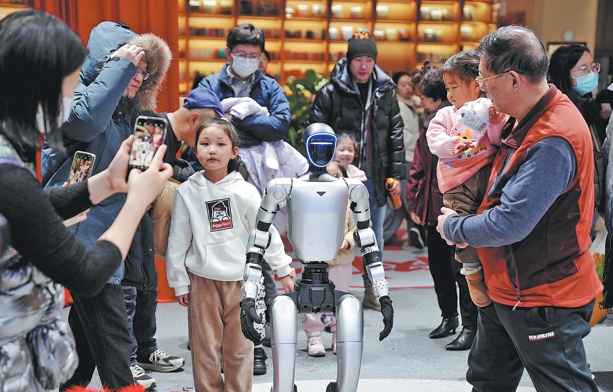
People interact with a robot from Unitree Robotics at the company's first offline store in Beijing on Dec 31. ZHANG XIANGYI/CHINA NEWS SERVICE
Economists say the early consumption surge reflects the combined effects of policy support, longer holidays and evolving consumer preferences.
The Central Economic Work Conference held in December placed expanding domestic demand as the top priority of China's economic policy in 2026, with multiple consumption-supporting policies already rolled out or in the pipeline.
Su Jian, a professor at Peking University's School of Economics, said consumption growth has been most visible in services and fast-evolving consumer electronics, including tourism, cultural products, sports and entertainment. Rapid upgrade cycles, he added, continue to support demand for electronics.
Since last year, targeted consumption-boosting campaigns have delivered tangible results. In 2025, trade-in-related sales exceeded 2.6 trillion yuan, benefiting more than 360 million consumer transactions. Optimized trade-in programs introduced in 2026 are now translating into concrete market activity across regions.
International observers have also noted structural changes underway. In its latest flagship annual report, global consultancy Roland Berger said China has entered the "consumption 4.0" era, characterized by resilience.
China's consumption structure is shifting rapidly from survival-oriented spending toward development — and experience-oriented demand, the report noted. By elevating domestic demand expansion to a strategic priority, and encouraging a move from quantitative satisfaction to qualitative enrichment, policymakers are using consumption upgrading to drive supply-side innovation and support high-quality growth.
Boosting consumption, policymakers emphasize, is not a short-term fix, but a long-term strategy.
A State Council executive meeting held on Jan 16 reviewed progress in the consumption-boosting campaign and outlined further steps to cultivate new growth points in service consumption.
The meeting called for improving long-term mechanisms for promoting consumption, raising urban and rural household incomes, implementing the paid leave system and removing unreasonable restrictive measures for consumption.
本文为作者独立观点,不代表上海新闻网高速路况立场,未经允许不得转载。















我们致力于提供一个高质量内容的交流平台。为落实国家互联网信息办公室“依法管网、依法办网、依法上网”的要求,为完善跟帖评论自律管理,为了保护用户创造的内容、维护开放、真实、专业的平台氛围,我们团队将依据本公约中的条款对注册用户和发布在本平台的内容进行管理。平台鼓励用户创作、发布优质内容,同时也将采取必要措施管理违法、侵权或有其他不良影响的网络信息。
一、根据《网络信息内容生态治理规定》《中华人民共和国未成年人保护法》等法律法规,对以下违法、不良信息或存在危害的行为进行处理。
1. 违反法律法规的信息,主要表现为:
1)反对宪法所确定的基本原则;
2)危害国家安全,泄露国家秘密,颠覆国家政权,破坏国家统一,损害国家荣誉和利益;
3)侮辱、滥用英烈形象,歪曲、丑化、亵渎、否定英雄烈士事迹和精神,以侮辱、诽谤或者其他方式侵害英雄烈士的姓名、肖像、名誉、荣誉;
4)宣扬恐怖主义、极端主义或者煽动实施恐怖活动、极端主义活动;
5)煽动民族仇恨、民族歧视,破坏民族团结;
6)破坏国家宗教政策,宣扬邪教和封建迷信;
7)散布谣言,扰乱社会秩序,破坏社会稳定;
8)宣扬淫秽、色情、赌博、暴力、凶杀、恐怖或者教唆犯罪;
9)煽动非法集会、结社、游行、示威、聚众扰乱社会秩序;
10)侮辱或者诽谤他人,侵害他人名誉、隐私和其他合法权益;
11)通过网络以文字、图片、音视频等形式,对未成年人实施侮辱、诽谤、威胁或者恶意损害未成年人形象进行网络欺凌的;
12)危害未成年人身心健康的;
13)含有法律、行政法规禁止的其他内容;
2. 不友善:不尊重用户及其所贡献内容的信息或行为。主要表现为:
1)轻蔑:贬低、轻视他人及其劳动成果;
2)诽谤:捏造、散布虚假事实,损害他人名誉;
3)嘲讽:以比喻、夸张、侮辱性的手法对他人或其行为进行揭露或描述,以此来激怒他人;
4)挑衅:以不友好的方式激怒他人,意图使对方对自己的言论作出回应,蓄意制造事端;
5)羞辱:贬低他人的能力、行为、生理或身份特征,让对方难堪;
6)谩骂:以不文明的语言对他人进行负面评价;
7)歧视:煽动人群歧视、地域歧视等,针对他人的民族、种族、宗教、性取向、性别、年龄、地域、生理特征等身份或者归类的攻击;
8)威胁:许诺以不良的后果来迫使他人服从自己的意志;
3. 发布垃圾广告信息:以推广曝光为目的,发布影响用户体验、扰乱本网站秩序的内容,或进行相关行为。主要表现为:
1)多次发布包含售卖产品、提供服务、宣传推广内容的垃圾广告。包括但不限于以下几种形式:
2)单个帐号多次发布包含垃圾广告的内容;
3)多个广告帐号互相配合发布、传播包含垃圾广告的内容;
4)多次发布包含欺骗性外链的内容,如未注明的淘宝客链接、跳转网站等,诱骗用户点击链接
5)发布大量包含推广链接、产品、品牌等内容获取搜索引擎中的不正当曝光;
6)购买或出售帐号之间虚假地互动,发布干扰网站秩序的推广内容及相关交易。
7)发布包含欺骗性的恶意营销内容,如通过伪造经历、冒充他人等方式进行恶意营销;
8)使用特殊符号、图片等方式规避垃圾广告内容审核的广告内容。
4. 色情低俗信息,主要表现为:
1)包含自己或他人性经验的细节描述或露骨的感受描述;
2)涉及色情段子、两性笑话的低俗内容;
3)配图、头图中包含庸俗或挑逗性图片的内容;
4)带有性暗示、性挑逗等易使人产生性联想;
5)展现血腥、惊悚、残忍等致人身心不适;
6)炒作绯闻、丑闻、劣迹等;
7)宣扬低俗、庸俗、媚俗内容。
5. 不实信息,主要表现为:
1)可能存在事实性错误或者造谣等内容;
2)存在事实夸大、伪造虚假经历等误导他人的内容;
3)伪造身份、冒充他人,通过头像、用户名等个人信息暗示自己具有特定身份,或与特定机构或个人存在关联。
6. 传播封建迷信,主要表现为:
1)找人算命、测字、占卜、解梦、化解厄运、使用迷信方式治病;
2)求推荐算命看相大师;
3)针对具体风水等问题进行求助或咨询;
4)问自己或他人的八字、六爻、星盘、手相、面相、五行缺失,包括通过占卜方法问婚姻、前程、运势,东西宠物丢了能不能找回、取名改名等;
7. 文章标题党,主要表现为:
1)以各种夸张、猎奇、不合常理的表现手法等行为来诱导用户;
2)内容与标题之间存在严重不实或者原意扭曲;
3)使用夸张标题,内容与标题严重不符的。
8.「饭圈」乱象行为,主要表现为:
1)诱导未成年人应援集资、高额消费、投票打榜
2)粉丝互撕谩骂、拉踩引战、造谣攻击、人肉搜索、侵犯隐私
3)鼓动「饭圈」粉丝攀比炫富、奢靡享乐等行为
4)以号召粉丝、雇用网络水军、「养号」形式刷量控评等行为
5)通过「蹭热点」、制造话题等形式干扰舆论,影响传播秩序
9. 其他危害行为或内容,主要表现为:
1)可能引发未成年人模仿不安全行为和违反社会公德行为、诱导未成年人不良嗜好影响未成年人身心健康的;
2)不当评述自然灾害、重大事故等灾难的;
3)美化、粉饰侵略战争行为的;
4)法律、行政法规禁止,或可能对网络生态造成不良影响的其他内容。
二、违规处罚
本网站通过主动发现和接受用户举报两种方式收集违规行为信息。所有有意的降低内容质量、伤害平台氛围及欺凌未成年人或危害未成年人身心健康的行为都是不能容忍的。
当一个用户发布违规内容时,本网站将依据相关用户违规情节严重程度,对帐号进行禁言 1 天、7 天、15 天直至永久禁言或封停账号的处罚。当涉及欺凌未成年人、危害未成年人身心健康、通过作弊手段注册、使用帐号,或者滥用多个帐号发布违规内容时,本网站将加重处罚。
三、申诉
随着平台管理经验的不断丰富,本网站出于维护本网站氛围和秩序的目的,将不断完善本公约。
如果本网站用户对本网站基于本公约规定做出的处理有异议,可以通过「建议反馈」功能向本网站进行反馈。
(规则的最终解释权归属本网站所有)


 评论
评论